What Happens to Gasoline and Batteries in a Boat or RV Left Parked for Six Months?
This is a subtitle for your new post
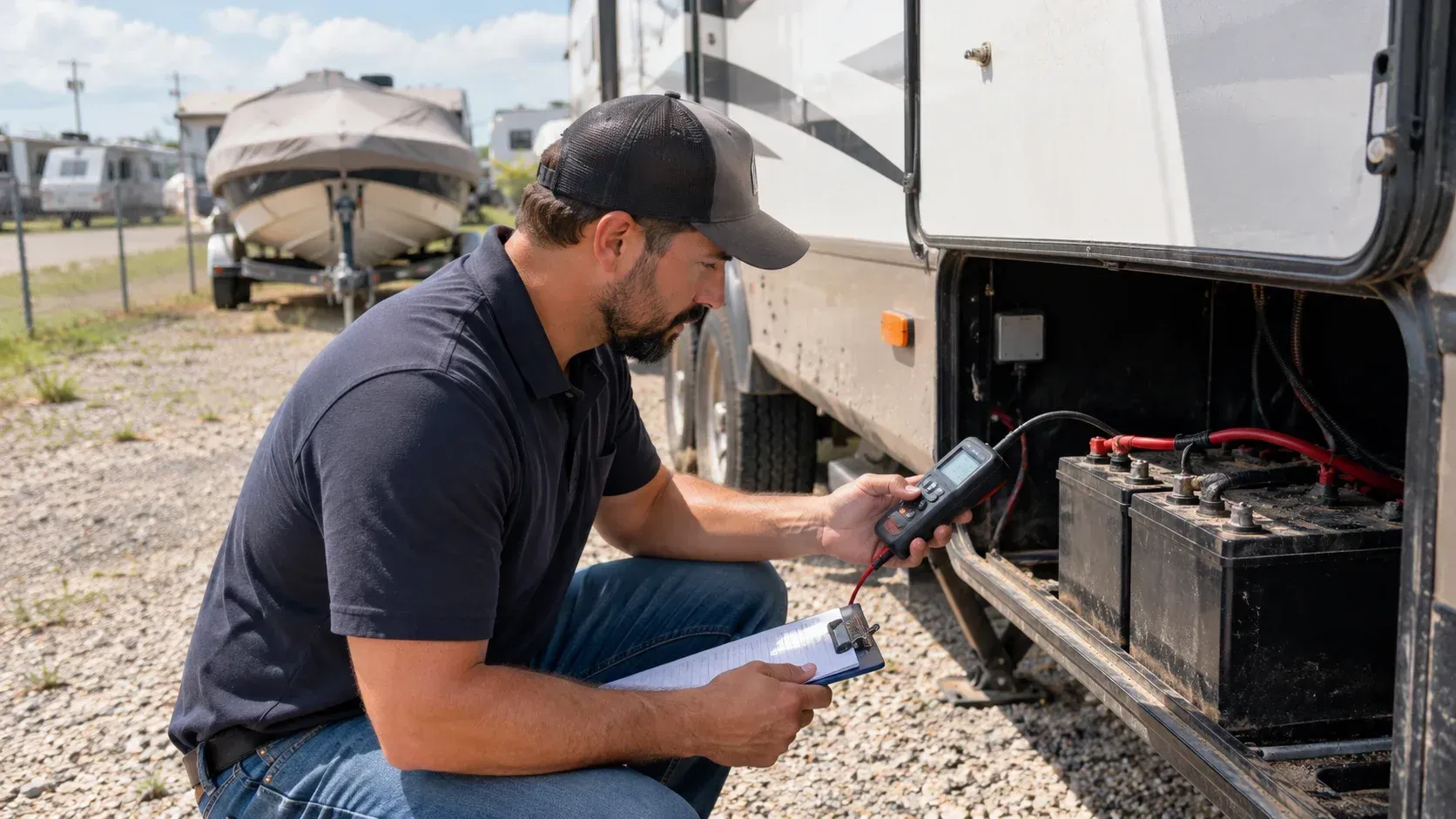
Table of Contents
- Introduction
- What Six Months Does to the Fuel
- What Six Months Does to the Battery
- Boat or RV Storage Prep That Actually Prevents This
- Full Tank or Empty Tank, and Why People Argue About It
- What Else Degrades During Long Term RV Storage
- Get Written Consent Before You Park a Fueled Vehicle
- Conclusion
- Store It Where the Rules Are Clear
- Frequently Asked Questions
Key Takeaways
- Ethanol blended gasoline draws in moisture and can separate, leaving varnish that clogs fuel systems.
- A lead acid battery left alone self discharges and sulfates, which permanently cuts its capacity.
- A fuel stabilizer added before the last run and a battery maintainer prevent nearly all of it.
- Running the engine briefly once a month does more harm than good.
- Any vehicle, RV, or boat with a fuel tank needs prior written consent before it comes onto the property.
Introduction
Gasoline in a boat or RV left in boat parking for six months can absorb moisture and begin breaking down, leaving varnish and water in the fuel system, while an unmaintained battery slowly self discharges and sulfates, losing capacity it never fully recovers. Both are preventable in an afternoon, and the customers who do the prep work drive out in spring without a tow.
The ones who do not tend to find out in April, usually on the ramp, usually with a boat full of people waiting.
What Six Months Does to the Fuel
Most pump gasoline contains ethanol, and ethanol is the reason stored fuel goes bad faster than it used to.
Two things happen while it sits:
- Moisture absorption. Ethanol attracts water from humid air, and the Gulf Coast supplies plenty. In a partly empty tank, humid air cycles in and out as temperatures swing.
- Phase separation. Once the fuel holds more water than it can carry, the water and ethanol drop out of the gasoline and settle at the bottom of the tank, right where the fuel pickup sits.
- Oxidation and varnish. Gasoline is not chemically stable over long periods. It oxidizes, forming gums and varnish that coat injectors, carburetor jets, and fuel lines.
Marine engines take this worse than cars. Boat tanks are vented to humid air, they often sit partly full, and a marine engine that ingests a slug of water and ethanol from the bottom of the tank is not going to run well, if at all.
The symptoms in spring are predictable. Hard starting, rough running, stalling under load, or a fuel filter that clogs within minutes of the first trip.
What Six Months Does to the Battery
A lead acid battery is never truly off, and six months of slow discharge is enough to do permanent damage.
Two processes run in parallel. The battery self discharges on its own chemistry, and anything still wired to it keeps drawing current. In an RV that can include propane detectors, clocks, radio memory, and alarm circuits. Those small draws are what flatten a battery far faster than self discharge alone.
The damage is sulfation. As a battery sits at a low state of charge, lead sulfate crystals form on the plates and harden. Some of that is reversible with a proper charge. Past a point it is not, and the battery simply holds less than it used to, forever.
What makes this frustrating is that the battery often still looks fine. It reads a reasonable voltage, it cranks once, and then it cannot do it again. Capacity is gone even though voltage looks acceptable.
Boat or RV Storage Prep That Actually Prevents This
Good boat or RV storage prep is about an hour of work, and it is almost entirely preventive rather than corrective.
Before you park it:
- Add fuel stabilizer, then run the engine. The stabilizer has to circulate through the entire fuel system, not just sit in the tank. Run it long enough to reach the injectors or carburetor.
- Deal with the battery. Either disconnect it, remove it and keep it somewhere you can maintain it, or leave it on a maintainer if power is available.
- Change the oil first. Used oil holds acids and moisture that attack bearings over months of sitting.
- Inflate the tires properly and move the vehicle occasionally if you can, so it is not resting on one spot the whole time.
- Close it up against pests, which includes sealing obvious entry points and removing every trace of food.
- Cover vents and exhaust loosely enough to breathe but tightly enough to keep wildlife out.
One thing to skip: starting the engine for five minutes once a month. It feels responsible and it is actively harmful. A short run never reaches full operating temperature, so it pulls moisture into the oil and exhaust without burning it off, and it drains more from the battery than it replaces. Either run it properly under load for a real distance, or leave it alone and prep it correctly.
Full Tank or Empty Tank, and Why People Argue About It
Both camps have a point, and which one is right depends on the tank.
| Approach | The argument for it | Where it falls down |
|---|---|---|
| Nearly full plus stabilizer | Less air space means less moisture and less condensation | A large tank of stabilized fuel still ages |
| Nearly empty | Little fuel left to degrade | Bare metal tank surfaces can corrode, and residue still varnishes |
For a boat with a vented tank, most people lean toward nearly full with stabilizer, because the vented air space is the problem. For small equipment you can run completely dry, empty often wins. For an RV it is usually full with stabilizer.
Check what your manufacturer recommends for your specific tank material and fuel system. That is the answer that applies to your machine, rather than the one that applies to someone else's.
What Else Degrades During Long Term RV Storage
Fuel and batteries get the attention. A few other things quietly age over the same six months.
- Tires lose pressure and can develop flat spots where the weight sits.
- Rubber seals and hoses dry out, particularly around windows, slide outs, and the water system.
- Fresh water systems grow things if they are left with water in them. Drain them.
- Fabric and upholstery suffer in humidity, which the Gulf Coast has in abundance.
- Rodents and insects find their way into anything left closed up, and they chew wiring.
Pest damage is the one that turns into a real repair bill. A mouse nest in an engine bay or a chewed wiring harness costs far more than the ten minutes it takes to seal things up and remove food before you walk away.
Get Written Consent Before You Park a Fueled Vehicle
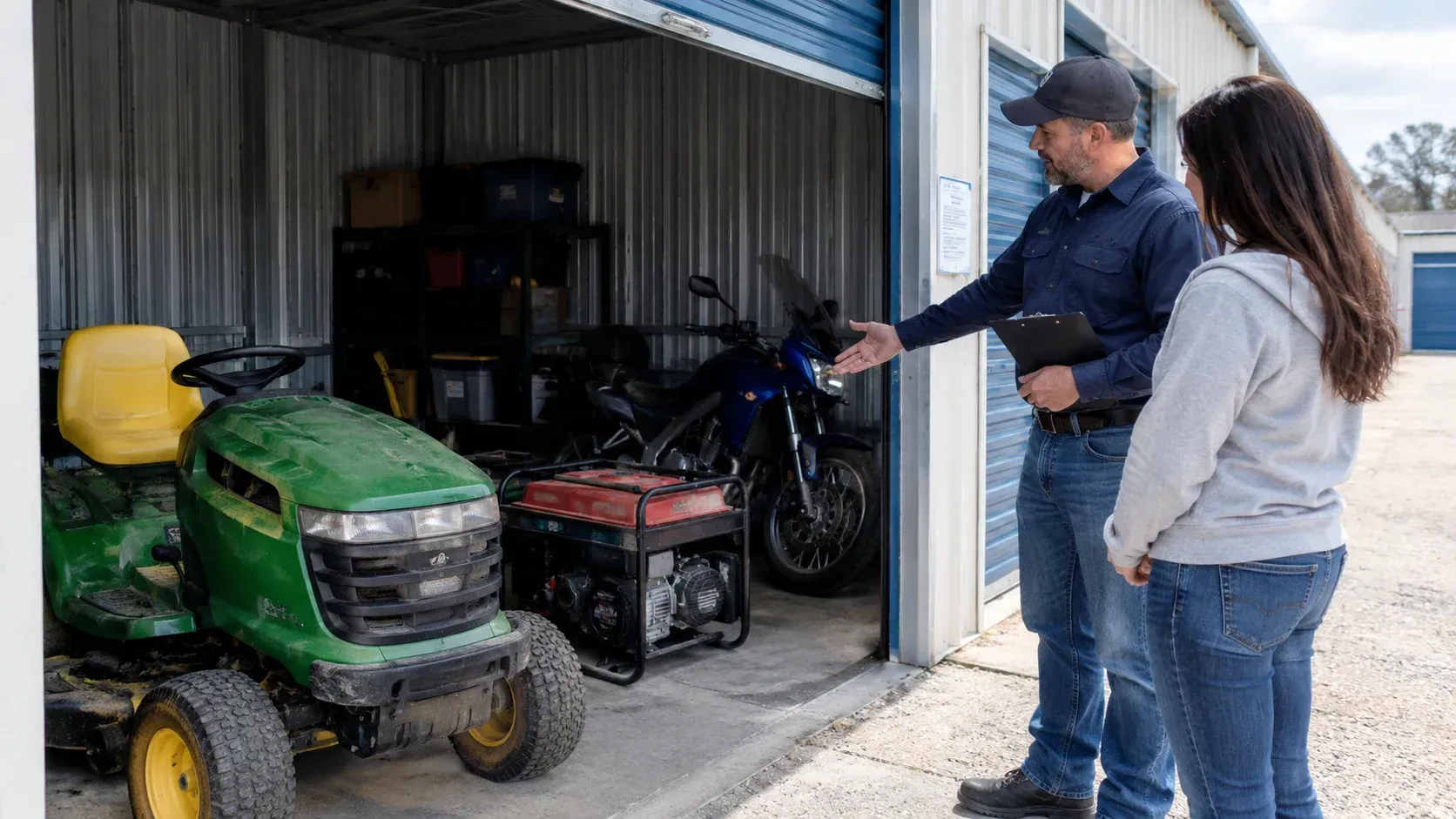
This part is a rule rather than advice. Vehicles, RVs, boats, and any items with a fuel tank require prior written consent before they are stored with us.
That is not a formality. It lets us confirm the space is right for the vehicle, document what is being stored, and make sure the fuel situation is understood by everyone. Our storage rules also prohibit hazardous materials and flammable liquids, so loose fuel containers are a separate matter from the tank attached to your boat. The same written consent requirement covers a motorcycle, mower, or generator, and the fueled equipment rules go into that in more detail.
Call before you show up with a fueled vehicle. It takes one conversation and it saves everyone a wasted trip.
Conclusion
Six months parked will not hurt a boat or RV that was prepped. It will cost you a fuel system flush and a battery if it was not. Stabilize the fuel and run it through the system, take the battery out of the equation, change the oil, seal it against pests, and resist the urge to idle it once a month. The prep is one afternoon. The alternative is a spring that starts with a mechanic instead of the water.
Store It Where the Rules Are Clear
Lone Star RV & Mini Storage has been family owned in Brazoria County since 2003, serving local families for over 20 years across three gated facilities with keypad entry, perimeter fencing, and exterior LED lighting. RV and boat parking is available at our Brooks Street location in Brazoria. Any fueled vehicle needs written approval first, so call (979) 798-5798 or reach the office before you bring it in and we will get it squared away the same business day.
Frequently Asked Questions
Does gasoline go bad in a boat or RV over six months?
It can. Ethanol blended fuel attracts moisture from humid air and can separate, dropping water to the bottom of the tank where the fuel pickup sits. Gasoline also oxidizes over time, forming gums and varnish that clog injectors, carburetor jets, and fuel lines.
Should I leave the fuel tank full or empty for storage?
A nearly full tank with stabilizer limits the air space that carries moisture, which suits vented boat and RV tanks. Running small equipment completely dry works better for it. Check what your manufacturer recommends for your tank and fuel system.
Will my battery die if I store my RV for six months?
Likely yes, and the damage is often permanent. Batteries self discharge, and parasitic draws from detectors, clocks, and alarms accelerate it. Sitting at low charge causes sulfation, which permanently reduces capacity. Disconnect it, remove it, or leave it on a maintainer.
Should I start the engine once a month during storage?
No. A short idle never reaches full operating temperature, so it introduces moisture into the oil and exhaust without burning it off, and it takes more out of the battery than it puts back. Either drive it properly or prep it and leave it.
Can I store a boat or RV with fuel in the tank?
At Lone Star, vehicles, RVs, boats, and any items with a fuel tank require prior written consent. Call before you arrive so we can confirm the space and document the vehicle. Loose fuel containers are separate and are not permitted.